2020–2022
National Natural Science Foundation of China, Young Scientists FundProject Title: The effect of clays and clay minerals on element cycling by adsorbing virusesRole: Principal investigator
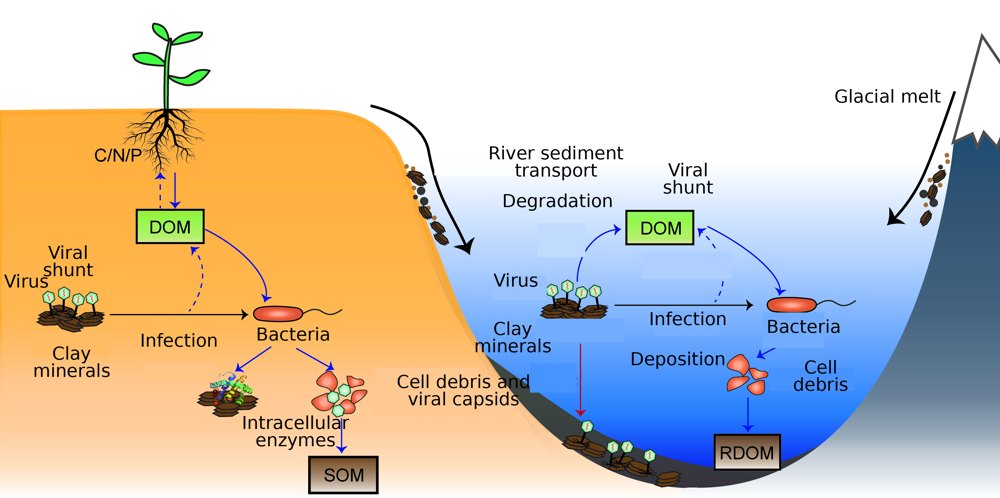
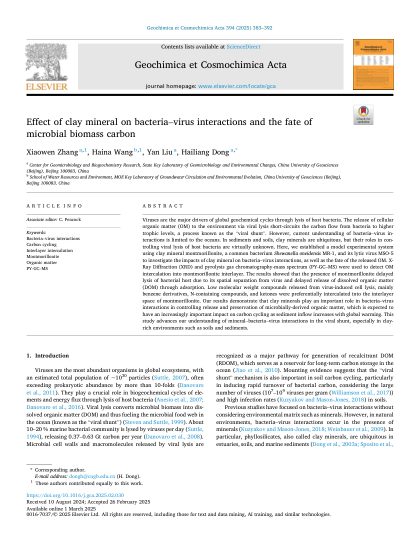
During my postdoctoral research at China University of Geosciences (Beijing), I began to ask a broader question: How do viral infection and lysis alter the fate of released organic matter, and thereby influence elemental biogeochemical cycling? I used a widely distributed Shewanella-bacteriophage interaction system and incorporated environmentally ubiquitous clay minerals to simulate more realistic conditions and to track the fate of dissolved organic matter (DOM) released by virus-induced lysis. This work yielded three main findings: (1) Clay minerals delay viral infection. Adsorption of both viruses and bacteria onto clay mineral surfaces increases physical separation between them, thereby delaying viral adsorption, infection, and host lysis. (2) Clay minerals delay the release of dissolved organic carbon (DOC) generated by viral lysis. DOC produced by phage-mediated lysis is absorbed by clay minerals and therefore does not rapidly accumulate in the aqueous phase, resulting in a delayed DOC release signal. (3) Low-molecular-weight organic compounds released by viral lysis can enter mineral interlayers, making them more prone to preservation. This provides mechanistic evidence that mineral-organic associations can stabilize lysis-derived compounds, leading to long-term retention.
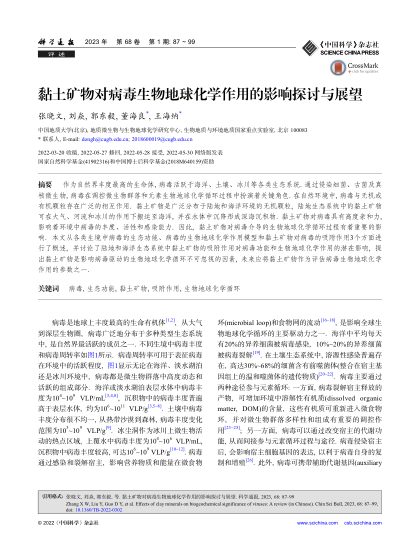
This work expands our understanding of how clay minerals modulate the contribution of virus-microbe interactions to carbon turnover. Moreover, it extends the classic viral shunt framework from aquatic systems to soils and sediments, establishing a mechanistic bridge between viral lysis and mineral-associated carbon stabilization. This work was supported by the NSFC Young Scientists Fund and a First-Class award from the China Postdoctoral Science Foundation, and the results were published in Geochimica et Cosmochimica Acta and Chinese Science Bulletin.
In the publication lists below, * co-first author, # corresponding author.
Coming soon